Online Euclidean Rhythm Generator
Turn pulse counts into balanced rhythmic orbits across kick, snare, hat and percussion. Rotate each track, override individual steps, add seeded variation and export exact audio or valid MIDI.
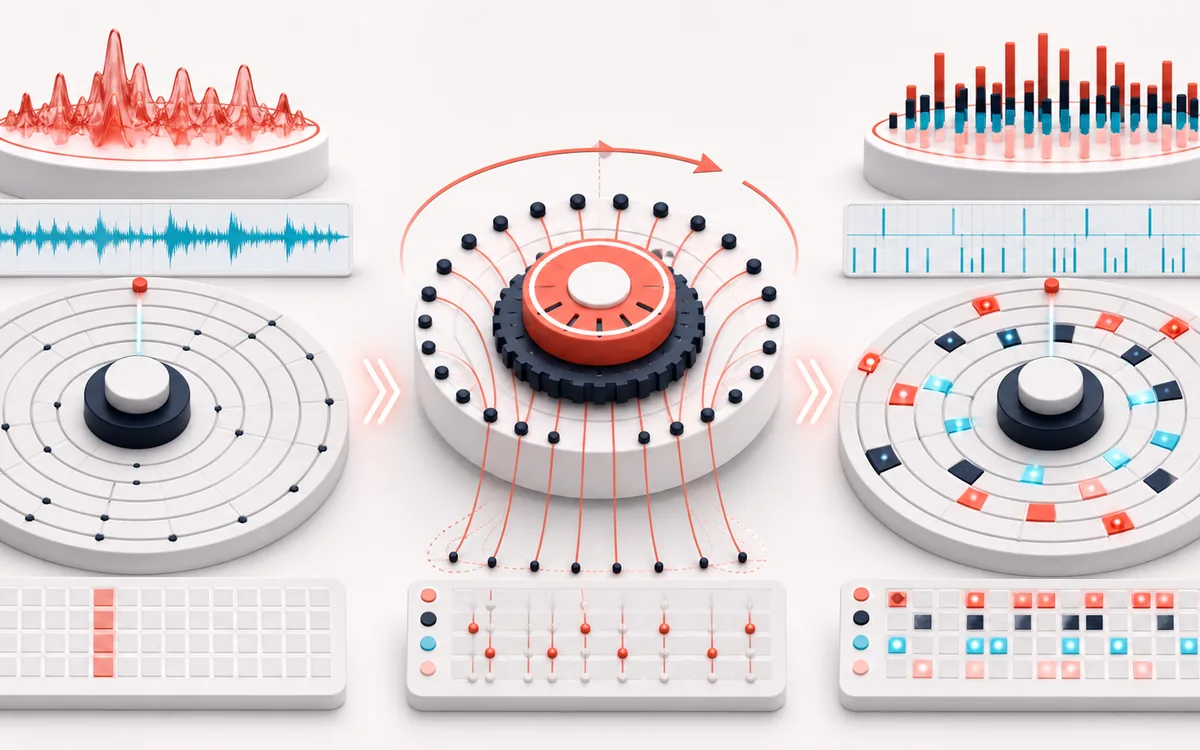
MUSICAL GRID MAP
Euclidean Pulse Rings
Connect detected or generated events to a musical grid. Pitch, rhythm and harmony become useful only when event timing, confidence and editable musical labels stay visible together.
Open the full signal breakdownBest source, processing logic, limits and three-pass listening check
- Track pulse settings
Start with the right material
Creating polymetric percussion, evenly spaced syncopation, rotating ostinatos and deterministic MIDI-ready starting patterns beyond a manual 16-step grid.
- Distribute rotating hits
Understand the transformation
A Euclidean/Bjorklund-style distribution resolves each track from steps and pulses; rotation, accents, levels, swing and optional seeded decisions are then applied to exact tick and sample positions.
- Polyrhythm pattern
Verify the usable result
Circular and step-grid pattern views with local playback plus deterministic MIDI, WAV, MP3 and JSON exports for the complete multi-track rhythm.
Where this workflow stops
Even pulse spacing is a mathematical pattern rule, not a claim of musical quality or cultural rhythm classification. Swing and probability alter timing or occurrence, and synthesized kit sounds are creative approximations.
Make the final decision by ear
- Confirm tempo, downbeat and key before trusting labels.
- Review low-confidence events by ear and correct them manually.
- Import the result into its target instrument or DAW before committing.
- Algorithm
- Björklund distribution keeps neighboring pulse gaps within one step before explicit overrides.
- Tracks
- Independent kick, snare, hat and percussion orbits with 8–32 steps, pulses, rotation, mute and level.
- Exports
- Exact-frame stereo WAV or MP3, Standard MIDI File at 480 PPQ and deterministic JSON event manifest.
How to generate a Euclidean drum rhythm
- Choose a starting orbit or begin from the custom four-track pattern.
- Set steps, pulses and rotation independently for kick, snare, hat and percussion.
- Set BPM, swing, bar count, kit character, track levels, mute, probability, accents and seed; open any step grid for explicit overrides.
- Render and play locally, then export exact WAV, MP3, valid MIDI or JSON.
Even pulse gaps with deliberate exceptions
The Björklund construction recursively groups onsets and rests so a requested number of pulses occupies the available steps as evenly as integer spacing permits. For example, E(3,8) produces 10010010 and E(5,13) produces 1001010010100. Rotation shifts the completed orbit without changing its internal gaps.
Grid overrides happen after generation and rotation. Each button cycles through Auto, Force on and Force off, so intentional syncopation is explicit and reversible. Once an override is used, the final track is no longer claimed to be strictly Euclidean.
Different from Beat Maker, Metronome and Bassline Generator
Beat Maker begins with manual placement on a conventional grid. Metronome provides a regular practice click. Bassline Generator creates pitched bass notes. This tool begins with an even-distribution algorithm for four drum lanes, then exposes rotation, seeded realization and optional manual exceptions.
Timing and deterministic variation
Every bar occupies exactly four quarter notes. Step time is derived independently for each track, while swing delays odd-numbered steps within their local pair without extending the bar. Probability and accent decisions hash the visible seed with track, bar and step coordinates, so identical settings realize identical audio, MIDI and JSON events.
- Audio tails at the final boundary are truncated rather than extending the selected duration.
- MP3 encoders can add codec delay or padding, while the source render and WAV frame count remain exact.
- The synthesized kits are original lightweight browser drum voices, not samples or named drum-machine emulations.
- MIDI uses General MIDI drum notes on channel 10, format 0, 480 PPQ, 4/4 time and the selected tempo.
Euclidean Rhythm Generator: quick answer and technical limits
Quick answer: A multi-track rhythm generator that distributes a chosen number of pulses as evenly as possible across a selected step count, then applies rotation and visible edits.
- Best for
- Creating polymetric percussion, evenly spaced syncopation, rotating ostinatos and deterministic MIDI-ready starting patterns beyond a manual 16-step grid.
- How it works
- A Euclidean/Bjorklund-style distribution resolves each track from steps and pulses; rotation, accents, levels, swing and optional seeded decisions are then applied to exact tick and sample positions.
- What you get
- Circular and step-grid pattern views with local playback plus deterministic MIDI, WAV, MP3 and JSON exports for the complete multi-track rhythm.
Know before you use it: Even pulse spacing is a mathematical pattern rule, not a claim of musical quality or cultural rhythm classification. Swing and probability alter timing or occurrence, and synthesized kit sounds are creative approximations.
Privacy: Selected audio is processed in this browser and is not uploaded to AudioWrench. Normal page assets can still be requested as described in the privacy notice. Privacy details →