Batch Loudness Matcher Online
Measure every track with one gated method, match the batch to a custom target or reference track, edit per-track trim, protect decoded sample peaks and export the actual aligned WAV files.
DYNAMICS MAP
Batch Level Targets
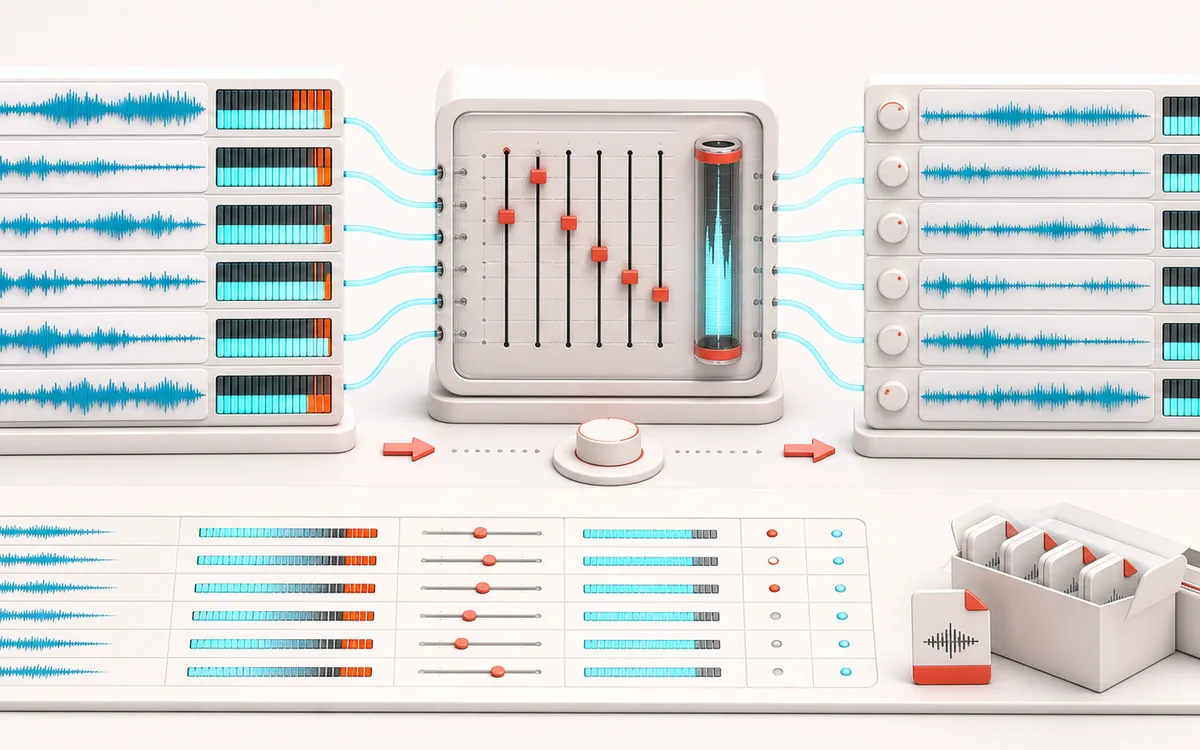
Follow the level decision, not just the waveform. The important story is how the detector reacts, where gain starts moving and whether the result stays controlled without flattening the performance.
Open the full signal breakdownBest source, processing logic, limits and three-pass listening check
- Mismatched track batch
Start with the right material
Evening out podcast episodes, playlist assets, sample deliveries, game dialogue or album drafts where audible level jumps matter more than merely listing measurements.
- Trim toward target
Understand the transformation
Each included track receives an editable gain derived from the same loudness estimate; optional peak protection bounds sample peaks before exact-rate, exact-channel WAV rendering.
- Matched audio batch
Verify the usable result
Sortable track comparison, predicted and measured output values, individual WAVs or a local ZIP plus CSV and JSON delivery manifests.
Where this workflow stops
The browser measurement is an engineering estimate rather than a certified broadcast meter, and simple gain matching does not make dynamics or spectral balance identical. Peak protection is not oversampled true-peak mastering.
Make the final decision by ear
- Compare at matched loudness so “louder” is not mistaken for “better”.
- Inspect the loudest transient and the quietest useful detail.
- Leave enough headroom for the next processing or delivery stage.
- One comparable measurement
- Every track uses the same 400 millisecond decoded-PCM energy blocks with absolute and relative gates, clearly labeled as an estimate rather than certified LUFS.
- Reference or custom target
- Match all included files toward a chosen estimate or inherit one track's measured level, then add intentional per-track trim.
- Real batch output
- Render each included waveform at its original decoded sample rate, channels and frame count, then download WAV files individually or inside one manifest-backed ZIP.
How to match loudness across multiple audio files
- Choose up to 32 local audio files or explicitly generate the three-level synthetic batch.
- Set a custom gated loudness estimate or choose one measured track as the batch reference, then configure the optional sample-peak ceiling.
- Measure every track with the same method, then edit include state and manual trim while checking predicted loudness, sample peak and headroom.
- Render included tracks without changing decoded frames, rates or channels, then download individual WAV files or one ZIP with CSV and JSON manifests.
A renderer, not another album report
Album Loudness Analyzer measures release consistency and flags QC risks without changing audio. This tool goes further: it turns the shared comparison into a gain plan, renders the included tracks and packages the outputs. For one file and standard target presets, use the Loudness Normalizer.
Why a peak-safe track may miss the loudness target
The optional ceiling is deliberately transparent: it constrains uniform gain instead of compressing or limiting peaks. When a dynamic track needs more gain than its decoded sample peak allows, the console shows that the ceiling reduced requested gain and predicts the lower achieved loudness. No dynamics are hidden and no true-peak compliance is claimed.
Privacy: selected files are decoded, measured, rendered and packaged on this device. They are not uploaded to AudioWrench.
Batch Loudness Matcher: quick answer and technical limits
Quick answer: A local multi-file renderer that measures every track with one consistent gated loudness estimate, targets a custom value or reference track and exports matched audio as a batch.
- Best for
- Evening out podcast episodes, playlist assets, sample deliveries, game dialogue or album drafts where audible level jumps matter more than merely listing measurements.
- How it works
- Each included track receives an editable gain derived from the same loudness estimate; optional peak protection bounds sample peaks before exact-rate, exact-channel WAV rendering.
- What you get
- Sortable track comparison, predicted and measured output values, individual WAVs or a local ZIP plus CSV and JSON delivery manifests.
Know before you use it: The browser measurement is an engineering estimate rather than a certified broadcast meter, and simple gain matching does not make dynamics or spectral balance identical. Peak protection is not oversampled true-peak mastering.
Privacy: Selected audio is processed in this browser and is not uploaded to AudioWrench. Normal page assets can still be requested as described in the privacy notice. Privacy details →