BWF Metadata Editor
Inspect a WAV chunk by chunk, edit Broadcast Wave bext, common LIST/INFO fields and raw iXML, then verify that audio data and every untouched chunk survived byte-for-byte.
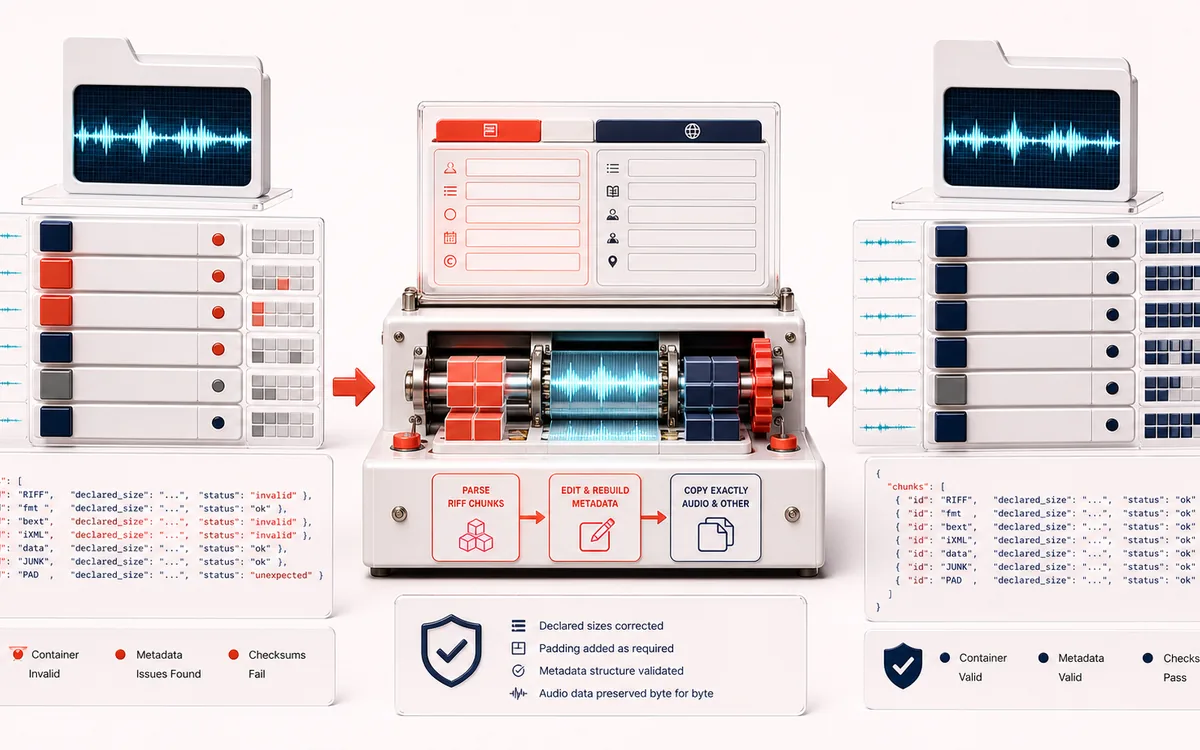
FILE STRUCTURE MAP
Broadcast Chunk Map
Follow audio, metadata and delivery as separate layers. Container work is easier to trust when decoded audio, editable fields and the final export are shown as distinct stages with explicit preservation limits.
Open the full signal breakdownBest source, processing logic, limits and three-pass listening check
- Broadcast WAV file
Start with the right material
Adding production descriptions, originator data, time reference, coding history and machine-readable project metadata to PCM or floating-point WAV deliveries.
- Edit RIFF metadata
Understand the transformation
The RIFF chunk table is parsed with declared sizes and padding; edited metadata chunks are rebuilt while audio data and unrecognized chunks are copied byte for byte into a corrected RIFF container.
- Preserved BWF
Verify the usable result
Visible chunk map and metadata validation plus an updated WAV and structured JSON chunk manifest.
Where this workflow stops
Support is limited to ordinary RIFF/WAVE files within browser memory limits. RF64, Wave64, compressed WAV variants and vendor-specific metadata semantics may require dedicated broadcast software.
Make the final decision by ear
- Keep the untouched original until the exported file is verified.
- Confirm sample rate, channels, duration and metadata independently.
- Test the delivery in the application or device that will consume it.
- RIFF-level visibility
- See chunk ids, offsets, sizes, padding, hashes and hex previews instead of treating a Broadcast Wave as an opaque audio file.
- Production metadata
- Edit bext identifiers and 64-bit sample time reference, common INFO descriptions and an entire syntactically validated iXML document.
- Verified preservation
- fmt, audio data and untouched chunks are copied from original byte ranges and compared before WAV or JSON export becomes available.
How to edit Broadcast Wave metadata online
- Open a local PCM or IEEE float RIFF/WAVE file, or explicitly generate the archive demo.
- Review the chunk map, including sizes, padding bytes, hashes and short hex summaries.
- Edit bext, INFO and iXML; validate fixed field lengths, 64-bit time reference, UMID and XML syntax.
- Build a verified RIFF, review the before/after diff and preservation status, then export WAV or JSON manifest.
Broadcast Wave metadata, not MP3 ID3 tags
The existing Metadata Editor edits ID3 frames attached to MP3 audio. BWF Metadata Editor works inside RIFF/WAVE: the Broadcast Audio Extension (`bext`), `LIST/INFO` subchunks and raw `iXML`. It never converts these structures into ID3 or decodes the audio payload.
What byte-preserving means here
The file is parsed into bounded RIFF chunks. Edited metadata chunks are rebuilt with corrected declared sizes and even-byte padding. The original raw bytes for `fmt `, every `data` chunk and every untouched or unknown chunk are carried forward and compared after reparsing the output. Missing edited metadata is inserted immediately after the first `fmt ` chunk in a deterministic order.
Supported boundary
This tool accepts PCM and IEEE float RIFF/WAVE, including the corresponding WAVE_FORMAT_EXTENSIBLE subformats. It deliberately refuses RF64, Wave64, compressed WAVE codecs, truncated chunks and malformed sizes. Files approaching RIFF's 4 GiB limit are outside the browser and container safety boundary.
Privacy: selected WAVE bytes remain in this browser. Parsing, XML validation, rebuilding, hashing and download preparation happen on this device.
BWF Metadata Editor: quick answer and technical limits
Quick answer: A local RIFF/WAVE inspector and editor for Broadcast Wave bext, iXML and LIST/INFO metadata that preserves the source audio chunk during export.
- Best for
- Adding production descriptions, originator data, time reference, coding history and machine-readable project metadata to PCM or floating-point WAV deliveries.
- How it works
- The RIFF chunk table is parsed with declared sizes and padding; edited metadata chunks are rebuilt while audio data and unrecognized chunks are copied byte for byte into a corrected RIFF container.
- What you get
- Visible chunk map and metadata validation plus an updated WAV and structured JSON chunk manifest.
Know before you use it: Support is limited to ordinary RIFF/WAVE files within browser memory limits. RF64, Wave64, compressed WAV variants and vendor-specific metadata semantics may require dedicated broadcast software.
Privacy: Selected audio is processed in this browser and is not uploaded to AudioWrench. Normal page assets can still be requested as described in the privacy notice. Privacy details →