Spectral Morph Online
Move between two recordings frame by frame in the frequency domain. Morph magnitudes and phases, interpolate complex spectra or cross-synthesize a new hybrid sound.
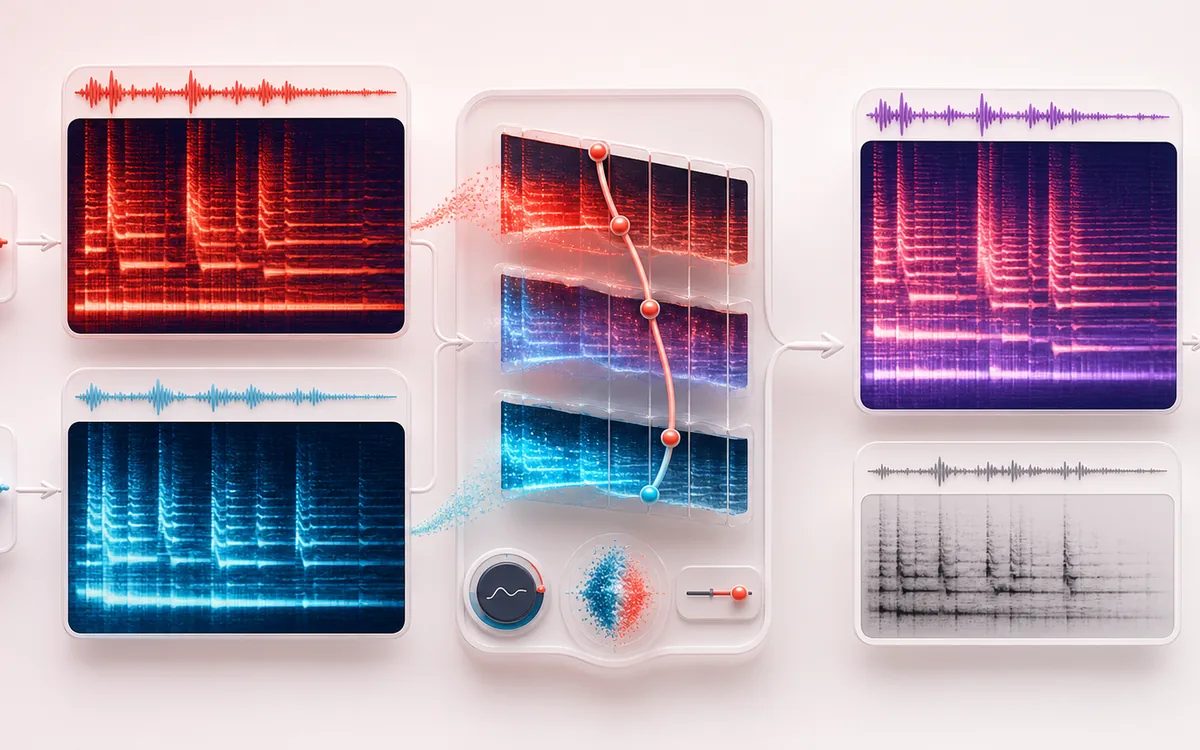
SPECTRAL MAP
Dual Spectrum Morph
See where tone changes across the frequency range. Read the curve from low to high frequency, then connect every visible move to something you can actually hear in the source.
Open the full signal breakdownBest source, processing logic, limits and three-pass listening check
- Source A and B
Start with the right material
Turning voices, instruments, ambience and sound effects into evolving hybrids, transitions and textures that retain characteristics of both selected recordings.
- Cross-synthesize frames
Understand the transformation
Both decoded sources are aligned to one local timeline, windowed spectral frames are analyzed, magnitude and phase behavior are resolved from the selected morph mode and controls, then overlap-add reconstruction returns a finite waveform.
- Hybrid sound
Verify the usable result
Source A, Source B, hybrid and Difference audition with spectral feedback plus an exact-timeline WAV or MP3 render.
Where this workflow stops
Frequency-domain blending can smear attacks and phase, especially when sources have unrelated timing or pitch. It does not separate stems, understand musical roles or match one mix tonally like Match EQ.
Make the final decision by ear
- Sweep or solo only to locate a problem; make the final decision in context.
- Watch broad tonal balance as well as narrow resonances.
- Recheck level after any boost so the comparison stays honest.
- Two moving sources
- Source A and B are aligned to one output timeline, then analyzed in synchronized overlapping Fourier frames.
- Three spectral engines
- Spectral magnitude/phase morph, direct complex interpolation and cross-synthesis create meaningfully different hybrids.
- Output
- Finite mono or stereo audio with chosen timeline length, diagnostic Difference, WAV and local MP3 export.
How to morph two sounds spectrally online
- Load Source A — the primary sound and timeline.
- Load Source B — the second evolving spectral character.
- Select a mode and length rule, then shape Morph, smoothing, phase character, transient protection and output gain.
- Render locally, compare A/B/Result/Difference and export.
A moving spectral hybrid — not static Match EQ
Match EQ averages an entire reference and applies one fixed tonal curve. Spectral Morph analyzes both recordings frame by frame. Their changing magnitude and phase information directly builds the result, so rhythm, texture and timbre from both sources can interact.
Spectral morph interpolates frequency magnitudes and phase character. Complex morph blends real and imaginary Fourier components, including phase cancellation. Cross-synthesis moves toward B's magnitude envelope while retaining A's timing and phase identity.
Creative controls and limits
- Length matching can preserve A, use the shorter timeline or expand to the longer timeline; the other source is mapped across that duration.
- Smoothing trades fine spectral detail for broader shapes. Transient protection restores some Source A around sharp events.
- Very unrelated sources can become noisy, hollow or metallic. Difference is the processing delta, not a separated stem.
- MP3 is a new lossy encode and may include codec padding. WAV preserves the chosen decoded frame count.
Privacy: both files are decoded, aligned, processed and encoded on this device and are not uploaded to AudioWrench. Normal page resources can still be requested according to the privacy notice.
Spectral Morph: quick answer and technical limits
Quick answer: A two-source frequency-domain processor that creates a new hybrid by blending or cross-synthesizing changing spectra frame by frame rather than applying one static reference curve.
- Best for
- Turning voices, instruments, ambience and sound effects into evolving hybrids, transitions and textures that retain characteristics of both selected recordings.
- How it works
- Both decoded sources are aligned to one local timeline, windowed spectral frames are analyzed, magnitude and phase behavior are resolved from the selected morph mode and controls, then overlap-add reconstruction returns a finite waveform.
- What you get
- Source A, Source B, hybrid and Difference audition with spectral feedback plus an exact-timeline WAV or MP3 render.
Know before you use it: Frequency-domain blending can smear attacks and phase, especially when sources have unrelated timing or pitch. It does not separate stems, understand musical roles or match one mix tonally like Match EQ.
Privacy: Selected audio is processed in this browser and is not uploaded to AudioWrench. Normal page assets can still be requested as described in the privacy notice. Privacy details →