Online Vocoder
Transfer the moving frequency shape of speech or any audio onto a saw, pulse or noise carrier. Tune the synth, patch 8–32 real analysis bands, compare the result and export without uploading your voice.
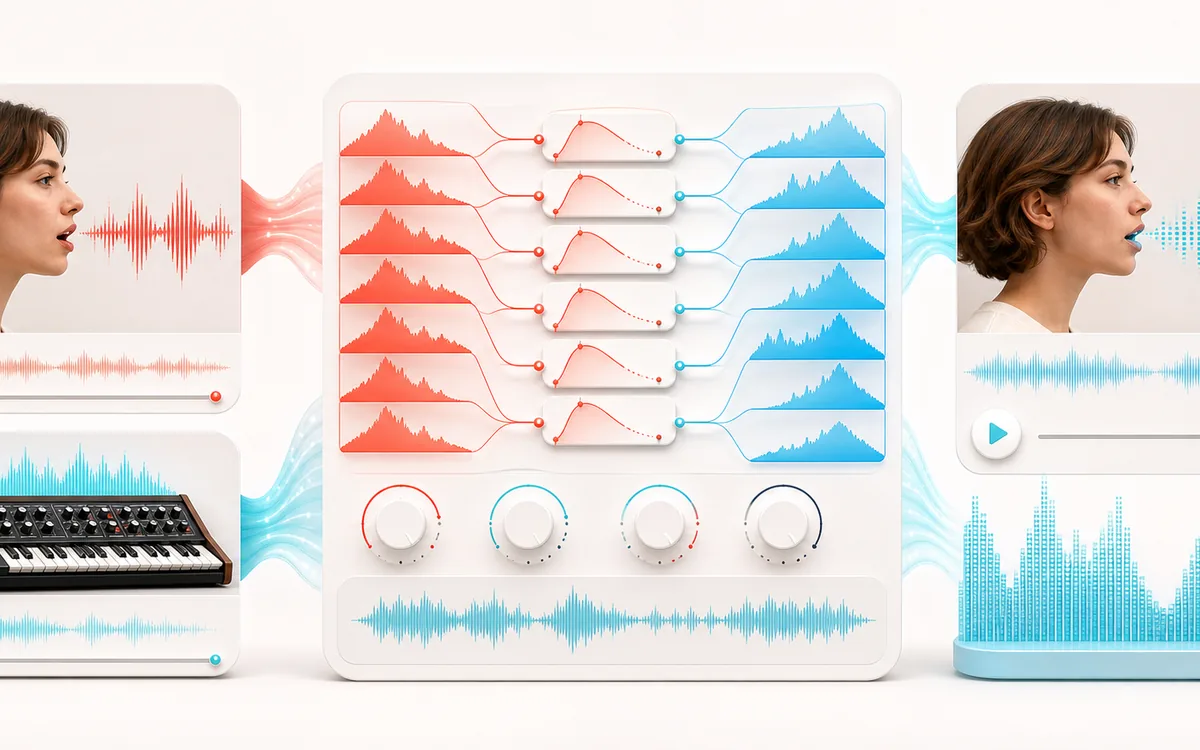
VOICE DETAIL MAP
Vocoder Band Matrix
Keep speech intelligible while changing only the target detail. The voice path makes phrases, breaths, consonants and tonal character visible as separate decisions instead of treating dialogue as one uniform waveform.
Open the full signal breakdownBest source, processing logic, limits and three-pass listening check
- Voice and carrier
Start with the right material
Robot vocals, sung synth textures, rhythmic speech effects and sound-design layers that should follow the timing and articulation of one local modulator recording.
- Transfer band envelopes
Understand the transformation
Matched analysis and synthesis filter banks follow each modulator band with attack and release smoothing, then scale carrier bands before unvoiced energy, stereo spread and mix are applied.
- Vocoded signal
Verify the usable result
Modulator, Carrier and Vocoder audition plus an exact-frame WAV or MP3 render from a selected carrier, band count and envelope setup.
Where this workflow stops
Intelligibility depends on clean speech, enough carrier harmonics and sensible envelope timing. It does not clone a speaker, preserve natural identity or convert arbitrary speech into accurate singing.
Make the final decision by ear
- Listen to complete phrases so edits retain natural timing.
- Protect consonants and breaths that carry intelligibility or emotion.
- Compare on both headphones and ordinary speakers before delivery.
- Analysis
- 8, 16, 24 or 32 logarithmic band-pass filters with independent attack/release envelope followers.
- Carrier
- Phase-continuous saw, pulse or deterministic noise synth with root note, octave and chord voicings.
- Output
- The decoded frame count, sample rate and channel count are retained for local WAV or MP3 export.
How to use the online vocoder
- Load a clean spoken or sung phrase, or start with the generated speech-like demo.
- Pick a preset, then set the number of bands, carrier waveform, note, octave and chord.
- Tune envelope timing, formant shift, brightness, consonant noise and stereo spread, then render.
- Compare the Modulator, Vocoder and Difference on one timeline before exporting WAV or MP3.
A real analysis-and-synthesis filter bank
The modulator and carrier each pass through matched logarithmic band-pass banks. Every modulator band is rectified and smoothed with its own attack/release envelope follower. That envelope controls the matching carrier band, so vowels open a spectral shape while the carrier supplies pitch and harmonics.
Formant shift offsets which modulator frequencies drive the carrier bands. Brightness tilts the synthesized band gains. Neither control estimates phonemes or uses a remote model.
Carrier and intelligibility choices
Saw provides dense harmonics and is the clearest default. Pulse is leaner and more electronic. Noise is unpitched and works for whispers or drums. More bands preserve narrower spectral movement, while fast attack and medium release usually keep consonants readable without chattering.
Limits worth knowing
- This is a classic filter-bank effect, not speech recognition, text-to-speech, stem separation or pitch correction.
- Noisy rooms, reverb and full mixes can create blurred envelopes. A dry, close vocal normally gives clearer words.
- Thirty-two bands cost more CPU and may sound thinner than sixteen bands on quiet recordings.
- The consonant/noise control restores unvoiced articulation heuristically; it does not identify actual phonemes.
- A finite sample bound prevents invalid output, but it is not a mastering true-peak limiter. Keep export headroom.
- Files over 80 MB, beyond 10 minutes or over the local memory plan are refused before processing.
Privacy: selected audio is decoded, processed and encoded in this browser. It is not sent to AudioWrench. Normal page assets can still be requested when the page loads.
Online Vocoder: quick answer and technical limits
Quick answer: A real filter-bank vocoder that measures changing energy across a voice or other modulator and applies those band envelopes to a harmonic synth carrier.
- Best for
- Robot vocals, sung synth textures, rhythmic speech effects and sound-design layers that should follow the timing and articulation of one local modulator recording.
- How it works
- Matched analysis and synthesis filter banks follow each modulator band with attack and release smoothing, then scale carrier bands before unvoiced energy, stereo spread and mix are applied.
- What you get
- Modulator, Carrier and Vocoder audition plus an exact-frame WAV or MP3 render from a selected carrier, band count and envelope setup.
Know before you use it: Intelligibility depends on clean speech, enough carrier harmonics and sensible envelope timing. It does not clone a speaker, preserve natural identity or convert arbitrary speech into accurate singing.
Privacy: Selected audio is processed in this browser and is not uploaded to AudioWrench. Normal page assets can still be requested as described in the privacy notice. Privacy details →