Vocal Formant Shifter Online
Move the broad vowel envelope without moving every harmonic. Keep the decoded pitch timeline in place, compare the exact change, and export a complete local render.
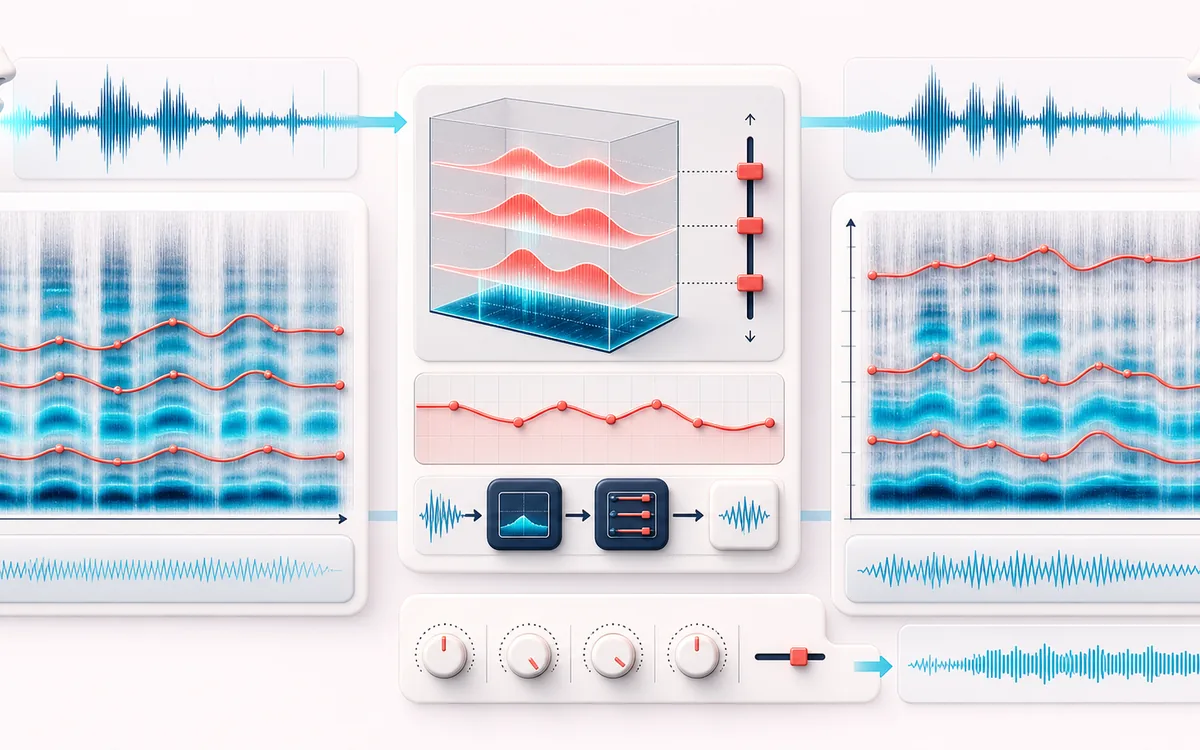
VOICE DETAIL MAP
Formant Envelope Shift
Keep speech intelligible while changing only the target detail. The voice path makes phrases, breaths, consonants and tonal character visible as separate decisions instead of treating dialogue as one uniform waveform.
Open the full signal breakdownBest source, processing logic, limits and three-pass listening check
- Monophonic vocal
Start with the right material
Making a monophonic dry vocal sound smaller, larger, brighter or darker without deliberately transposing the sung note as a normal pitch shifter would.
- Move spectral envelope
Understand the transformation
Windowed spectral-envelope estimation separates broad vocal resonances from fine harmonic structure, shifts the envelope across frequency and recombines it with the original excitation through overlap-add synthesis.
- Retimbred voice
Verify the usable result
Original, Shifted and Difference monitoring plus an exact-frame WAV or MP3 render from a preset or custom formant, smoothing, tilt and mix setup.
Where this workflow stops
It works best on one dry voice. Polyphony, heavy reverb, consonants and extreme shifts can create metallic or hollow artifacts, and fundamental-pitch stability is approximate rather than a voice-identity guarantee.
Make the final decision by ear
- Listen to complete phrases so edits retain natural timing.
- Protect consonants and breaths that carry intelligibility or emotion.
- Compare on both headphones and ordinary speakers before delivery.
- Envelope engine
- Overlapping FFT frames separate broad spectral shape from harmonic detail, remap the envelope and reconstruct the original frame timeline.
- Pitch behavior
- Harmonic-bin positions and phase progression stay in place, so clean monophonic vowel fundamentals remain approximately stable.
- Output
- Original decoded sample rate, channel count and frame count; synchronized Difference audition and local WAV or MP3 export.
How to shift vocal formants online
- Load a dry isolated vocal or generate the deterministic vowel-like demo.
- Start with Bright Focus, Warm Depth, Open Vowel or Soft Round, then adjust the envelope controls.
- Render locally and switch between Original, Processed and Difference at the same playhead position.
- Download the complete processed frame timeline as WAV or a new MP3 encode.
A formant-domain processor, not another pitch shifter
A pitch shifter moves the fundamental and its harmonics together. This processor keeps those fine harmonic locations in place, estimates a slower-moving spectral envelope, and samples that envelope at a shifted frequency ratio. Strength blends the remapped envelope with the original shape; it does not add another voice.
Envelope smoothing decides how broadly the spectrum is interpreted. Higher values follow vowel-scale resonance regions instead of individual harmonics. Clarity applies a bounded tilt after envelope remapping, while mix blends the processed signal with the original at the same sample positions.
Know the limits before rendering
- Best results come from a dry isolated monophonic vocal with clear sustained vowels.
- Consonants, sibilance, plosives, reverb, polyphony and full mixes can sound hollow, metallic or smeared.
- Large shifts expose FFT resolution and envelope-estimation limits; compare the Difference view and reduce Strength when needed.
- The tool does not correct notes, detect a key, create harmony voices, separate vocals or infer identity, gender, health or voice type.
- Files above 80 MB, longer than 15 minutes or beyond the screen-specific local memory budget are refused before rendering.
Privacy: selected audio is decoded, processed and encoded in this browser and is not uploaded to AudioWrench. Normal page resources can still be requested according to the privacy notice.
Vocal Formant Shifter: quick answer and technical limits
Quick answer: A vocal timbre processor that remaps a short-time spectral envelope upward or downward while aiming to keep the source fundamental pitch and decoded timeline stable.
- Best for
- Making a monophonic dry vocal sound smaller, larger, brighter or darker without deliberately transposing the sung note as a normal pitch shifter would.
- How it works
- Windowed spectral-envelope estimation separates broad vocal resonances from fine harmonic structure, shifts the envelope across frequency and recombines it with the original excitation through overlap-add synthesis.
- What you get
- Original, Shifted and Difference monitoring plus an exact-frame WAV or MP3 render from a preset or custom formant, smoothing, tilt and mix setup.
Know before you use it: It works best on one dry voice. Polyphony, heavy reverb, consonants and extreme shifts can create metallic or hollow artifacts, and fundamental-pitch stability is approximate rather than a voice-identity guarantee.
Privacy: Selected audio is processed in this browser and is not uploaded to AudioWrench. Normal page assets can still be requested as described in the privacy notice. Privacy details →