Online Spectral Freeze
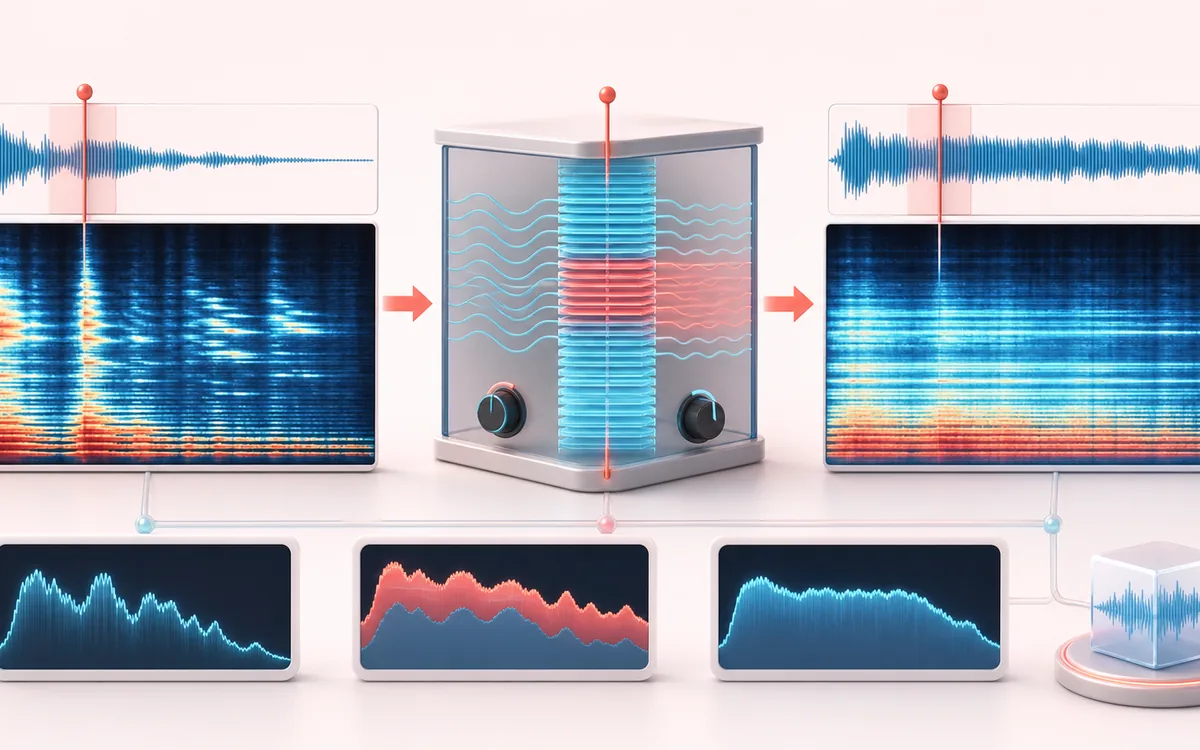
Capture the frequency fingerprint of one instant and turn it into a sustained stereo texture. Shape its focus, motion, brightness and decay, then export an exact-duration freeze.
SPECTRAL MAP
Frozen Spectrum Frame
See where tone changes across the frequency range. Read the curve from low to high frequency, then connect every visible move to something you can actually hear in the source.
Open the full signal breakdownBest source, processing logic, limits and three-pass listening check
- Chosen audio moment
Start with the right material
Holding one harmonic colour from a pad, vocal or instrument to make drones, transitions and sound-design layers without looping a visible waveform segment.
- Hold spectral bins
Understand the transformation
A short-time Fourier transform captures one bounded frame, smooths and shapes its magnitude spectrum, then overlap-add synthesis evolves phase while preserving the selected spectral envelope.
- Sustained texture
Verify the usable result
Source, Frozen and Difference monitoring plus a custom-duration WAV or MP3 render made from the captured spectrum and current motion settings.
Where this workflow stops
The output sustains spectral energy rather than preserving words, rhythm or transient timing. Small FFT sizes blur pitch detail, while large sizes can smear fast changes and expose metallic phase texture.
Make the final decision by ear
- Sweep or solo only to locate a problem; make the final decision in context.
- Watch broad tonal balance as well as narrow resonances.
- Recheck level after any boost so the comparison stays honest.
- Capture engine
- Hann-windowed radix-2 FFT at a selected source time, from 1024 to 8192 samples.
- Synthesis
- Bounded phase-continuous oscillator-bank resynthesis from captured magnitudes - not a repeated PCM loop.
- Output contract
- Stereo at the decoded sample rate and exactly the requested duration after frame rounding; WAV or MP3 export.
How to freeze a moment of audio
- Choose mono or stereo audio, or generate the deterministic harmonic demo.
- Move the freeze scrubber or enter a precise time, then choose FFT size and a preset.
- Shape duration, blur, phase motion, decay, brightness, stereo spread and source attack.
- Render locally, switch between Source and Frozen, and export the complete texture.
A frequency-domain hold, not an audio loop
Spectral Freeze takes one windowed FFT frame and stores the amplitude and starting phase of its bins. It then builds a new continuous signal from those bins. Spectral blur smooths neighboring magnitudes, brightness tilts them around 1 kHz, and phase motion adds slow deterministic movement while every oscillator remains continuous.
The optional source attack uses only a bounded slice immediately before the selected moment and crossfades it into synthesis. It does not repeat that slice. Set the attack to zero for a fully synthesized start.
Conventional DSP limits
- A single frame represents one moment, so speech, notes, rhythm and transients stop evolving after capture.
- A larger FFT resolves closer frequencies but spans more time. At 48 kHz, 8192 samples cover about 171 ms.
- Blur can turn narrow peaks into clusters; phase movement can create gentle sidebands; extreme brightness can exaggerate noise.
- The bounded oscillator count favors the strongest captured bins for predictable browser memory and render time.
- This is a creative spectral effect, not source restoration, forensic analysis, formant preservation or physical-model synthesis.
Privacy: selected audio is decoded, analyzed, synthesized and encoded in this browser. It is not sent to AudioWrench. Normal page assets can still be requested when the page loads.
Spectral Freeze: quick answer and technical limits
Quick answer: A local spectral effect that captures the frequency magnitudes at one selected moment and resynthesizes them as a sustained, evolving texture of a chosen duration.
- Best for
- Holding one harmonic colour from a pad, vocal or instrument to make drones, transitions and sound-design layers without looping a visible waveform segment.
- How it works
- A short-time Fourier transform captures one bounded frame, smooths and shapes its magnitude spectrum, then overlap-add synthesis evolves phase while preserving the selected spectral envelope.
- What you get
- Source, Frozen and Difference monitoring plus a custom-duration WAV or MP3 render made from the captured spectrum and current motion settings.
Know before you use it: The output sustains spectral energy rather than preserving words, rhythm or transient timing. Small FFT sizes blur pitch detail, while large sizes can smear fast changes and expose metallic phase texture.
Privacy: Selected audio is processed in this browser and is not uploaded to AudioWrench. Normal page assets can still be requested as described in the privacy notice. Privacy details →