Online Ring Modulator
Multiply audio by a real bipolar carrier, from slow amplitude motion to metallic sidebands. Shape the carrier, sync it to tempo, offset stereo phase, compare the exact difference and export without uploading your file.
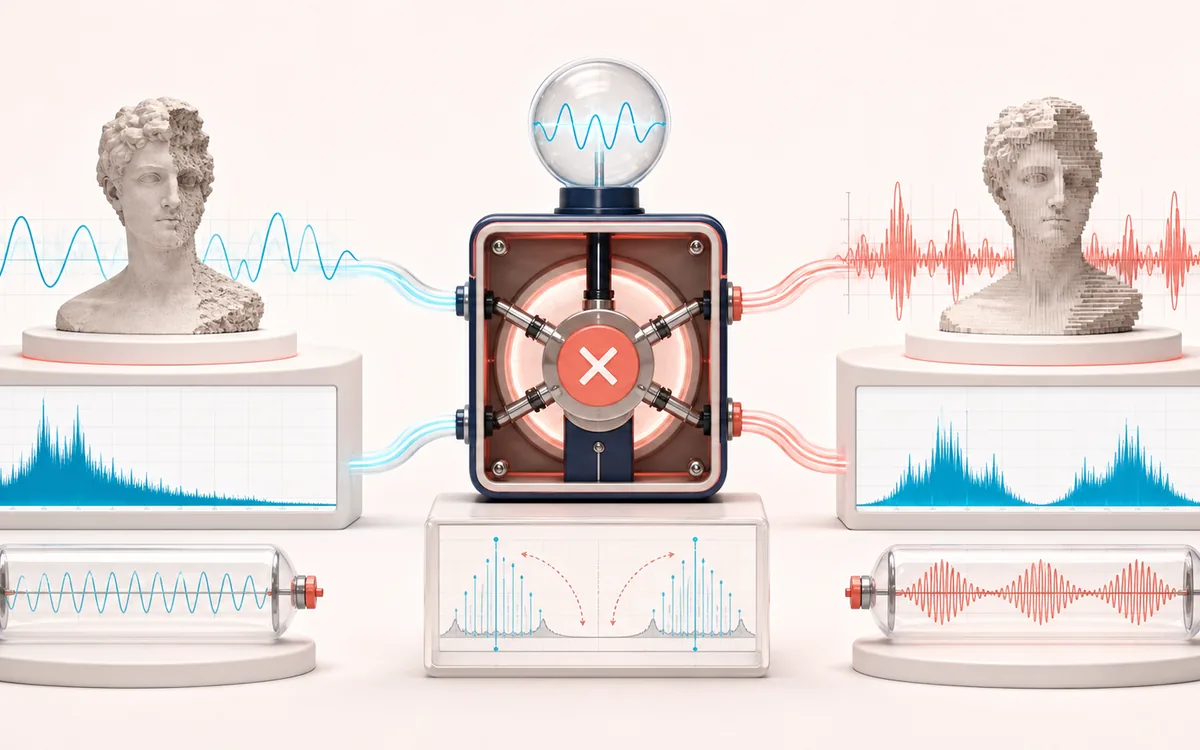
SPECTRAL MAP
Sideband Generator View
See where tone changes across the frequency range. Read the curve from low to high frequency, then connect every visible move to something you can actually hear in the source.
Open the full signal breakdownBest source, processing logic, limits and three-pass listening check
- Audio and carrier
Start with the right material
Slow tremolo, robotic speech, metallic percussion, bell-like textures and stereo carrier movement that needs more control than a fixed character preset.
- Multiply signals
Understand the transformation
A phase-continuous sine, triangle, square or saw carrier runs at the selected Hz or BPM division; depth, stereo phase, wet/dry and output controls define the exact multiplication path.
- Ring-modulated result
Verify the usable result
Original, processed and Difference monitoring plus an exact-duration WAV or MP3 render with the chosen carrier and modulation settings.
Where this workflow stops
Audio-rate ring modulation is intentionally inharmonic on most sources and is not musical pitch shifting. Square and saw carriers add extra harmonics, while low-frequency settings can create strong level pulses.
Make the final decision by ear
- Sweep or solo only to locate a problem; make the final decision in context.
- Watch broad tonal balance as well as narrow resonances.
- Recheck level after any boost so the comparison stays honest.
- Carrier
- Sine, triangle, square or zero-mean saw at 0.1-2000 Hz, direct Hz or BPM-synchronized.
- Signal path
- Phase-continuous carrier multiplication, Depth blend toward unity, stereo carrier phase, Dry/Wet, Output and finite sample bound.
- Output
- Same decoded sample rate, channel count, frame count and duration; local 16-bit WAV or MP3.
How to ring-modulate audio online
- Choose a browser-supported audio file or generate the deterministic local demo.
- Pick a preset, carrier waveform and frequency, or switch to BPM Sync and choose a musical division.
- Set Depth, stereo phase, Dry/Wet and Output, then process locally.
- Compare Original, Processed and Difference, then download the exact-duration result as WAV or MP3.
True bipolar multiplication
A ring modulator multiplies every source sample by a carrier from -1 to +1. With a pure 440 Hz sine and a 100 Hz sine carrier, the full-wet output contains strong components near 340 Hz and 540 Hz. The carrier runs from absolute sample position, so its phase is continuous across internal processing chunks.
Depth blends the carrier toward a constant gain of one before multiplication: low values retain more natural amplitude, while 100% gives true bipolar ring modulation. Dry/Wet then blends the untouched input with that modulated result. These are separate controls.
Hz, tempo sync and stereo motion
Hz mode runs from 0.1 Hz for slow motion to 2000 Hz for dense sidebands. BPM Sync maps whole, half, quarter, eighth, sixteenth and triplet divisions to exact cycles per beat. Stereo Phase offsets the carrier on the right and alternating later channels; it never shifts or delays the source waveform.
The carrier and sideband drawing is an explanatory prediction based on the current settings. It is deliberately not labeled as an FFT or measured spectrum.
Limits worth knowing
- Square, triangle and saw carriers create more sidebands than a sine carrier. Frequencies above Nyquist can alias; this tool does not claim oversampling.
- Ring modulation is not pitch correction or source-aware pitch shifting. Its inharmonic sidebands are often the intended sound.
- The sample bound prevents non-finite and out-of-range output, but it is not a true-peak limiter. Leave output headroom before lossy export.
- Files over 80 MB, longer than 15 minutes or beyond the screen-specific local memory budget are refused before rendering.
- Difference is Processed minus Original, sample by sample. It is not a separated stem and is never exported.
Privacy: selected audio is decoded, processed and encoded in this browser. It is not sent to AudioWrench. Normal page assets can still be requested when the page loads.
Ring Modulator: quick answer and technical limits
Quick answer: A local ring modulator that multiplies every source sample by a free-running or tempo-synced carrier to create amplitude motion and audio-rate sidebands.
- Best for
- Slow tremolo, robotic speech, metallic percussion, bell-like textures and stereo carrier movement that needs more control than a fixed character preset.
- How it works
- A phase-continuous sine, triangle, square or saw carrier runs at the selected Hz or BPM division; depth, stereo phase, wet/dry and output controls define the exact multiplication path.
- What you get
- Original, processed and Difference monitoring plus an exact-duration WAV or MP3 render with the chosen carrier and modulation settings.
Know before you use it: Audio-rate ring modulation is intentionally inharmonic on most sources and is not musical pitch shifting. Square and saw carriers add extra harmonics, while low-frequency settings can create strong level pulses.
Privacy: Selected audio is processed in this browser and is not uploaded to AudioWrench. Normal page assets can still be requested as described in the privacy notice. Privacy details →