Album Loudness Analyzer
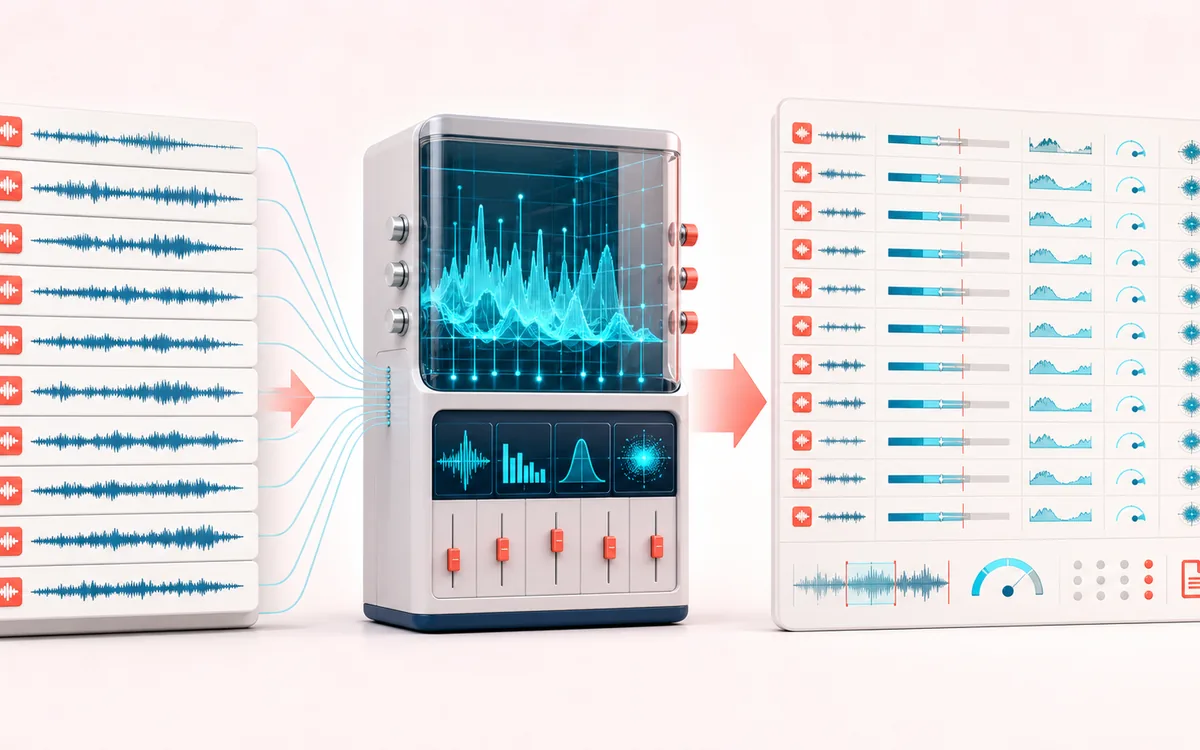
Compare a whole release at once: gated loudness approximation, RMS, sample peak, crest factor, stereo correlation, album range and target flags — without changing or uploading any track.
MEASUREMENT MAP
Album Consistency Table
Turn a signal into evidence you can inspect. A useful analyzer connects the raw trace, the measurement window and a clearly labeled result without pretending that one number explains the whole recording.
Open the full signal breakdownBest source, processing logic, limits and three-pass listening check
- Album track batch
Start with the right material
Finding unexpectedly loud, quiet, clipped, flat or phase-risky tracks before an album, EP, podcast series or sample delivery is released.
- Measure track loudness
Understand the transformation
Every selected file is decoded locally and scanned with the same bounded peak, RMS, gated loudness-estimate, crest-factor and stereo-correlation calculations before album aggregates and flags are resolved.
- Album QC report
Verify the usable result
Sortable per-track metrics, album range and consistency flags plus CSV and JSON reports in the chosen track order; the source files are not modified.
Where this workflow stops
Browser measurements are digital release checks, not calibrated SPL readings or a substitute for platform certification and listening. The labelled loudness value is an approximation unless the implementation explicitly passes a full standard conformance test.
Make the final decision by ear
- Use the same window and settings when comparing two files.
- Treat estimates as evidence, not as a substitute for listening.
- Export or note the measurement context alongside the result.
- Per track
- Duration, sample rate, channels, gated energy loudness approximation, RMS, sample peak, crest and stereo correlation.
- Album QC
- Duration-weighted album loudness approximation, loudness range, loudest peak, target flags and phase-risk count.
- Report
- Exact visible track order and album aggregates exported locally as CSV or structured JSON.
How to check album loudness online
- Load multiple mastered tracks or start with the three-track synthetic QC demo.
- Choose a comparison preset; it creates flags only and never changes audio.
- Analyze locally, then compare loudness approximation, RMS, peak, crest and stereo correlation across the tracklist.
- Sort or manually reorder the release and export the final visible rows plus album summary as CSV or JSON.
Analysis-only release QC
This dashboard measures many independent tracks together. It does not normalize, limit, resample, tag or export audio. That makes it distinct from Loudness Normalizer and the single-file Audio File Analyzer: the value here is cross-track consistency, order-aware album aggregates and a reusable QC report.
What “loudness approximation” means
The meter calculates 400 ms multi-channel energy blocks, removes blocks below an absolute −70 threshold, then applies a relative gate 10 dB below the first gated mean. The result uses the familiar −0.691 energy offset, but it is deliberately labeled an approximation because this implementation does not claim certified K-weighting, channel weighting or true-peak oversampling.
Limits worth knowing
- Peak is decoded sample peak, not oversampled intersample true peak.
- Correlation uses the first two channels. Mono returns +1 by definition; multichannel layouts are not fully spatially characterized.
- Target presets are editorial reference ranges, not platform guarantees. Services may change playback normalization behavior.
- Very short tracks under one 400 ms block use their available full-file energy.
- The batch is limited to 64 files, 200 MB selected compressed input, 20 minutes per track and the decoded-memory preflight.
Privacy: selected tracks are decoded and measured in this browser. They are not uploaded and no modified audio is created. Normal page assets may still be requested when the page loads.
Album Loudness Analyzer: quick answer and technical limits
Quick answer: A batch release-QC workspace that measures multiple tracks consistently and compares their duration, level, crest and stereo behavior as one ordered album or playlist.
- Best for
- Finding unexpectedly loud, quiet, clipped, flat or phase-risky tracks before an album, EP, podcast series or sample delivery is released.
- How it works
- Every selected file is decoded locally and scanned with the same bounded peak, RMS, gated loudness-estimate, crest-factor and stereo-correlation calculations before album aggregates and flags are resolved.
- What you get
- Sortable per-track metrics, album range and consistency flags plus CSV and JSON reports in the chosen track order; the source files are not modified.
Know before you use it: Browser measurements are digital release checks, not calibrated SPL readings or a substitute for platform certification and listening. The labelled loudness value is an approximation unless the implementation explicitly passes a full standard conformance test.
Privacy: Selected audio is processed in this browser and is not uploaded to AudioWrench. Normal page assets can still be requested as described in the privacy notice. Privacy details →