ABX Audio Comparator
Find out whether you can repeatedly identify a difference between two audio files. Switch A, B and hidden X at one continuous playhead, answer randomized trials, and interpret the binomial chance result cautiously.
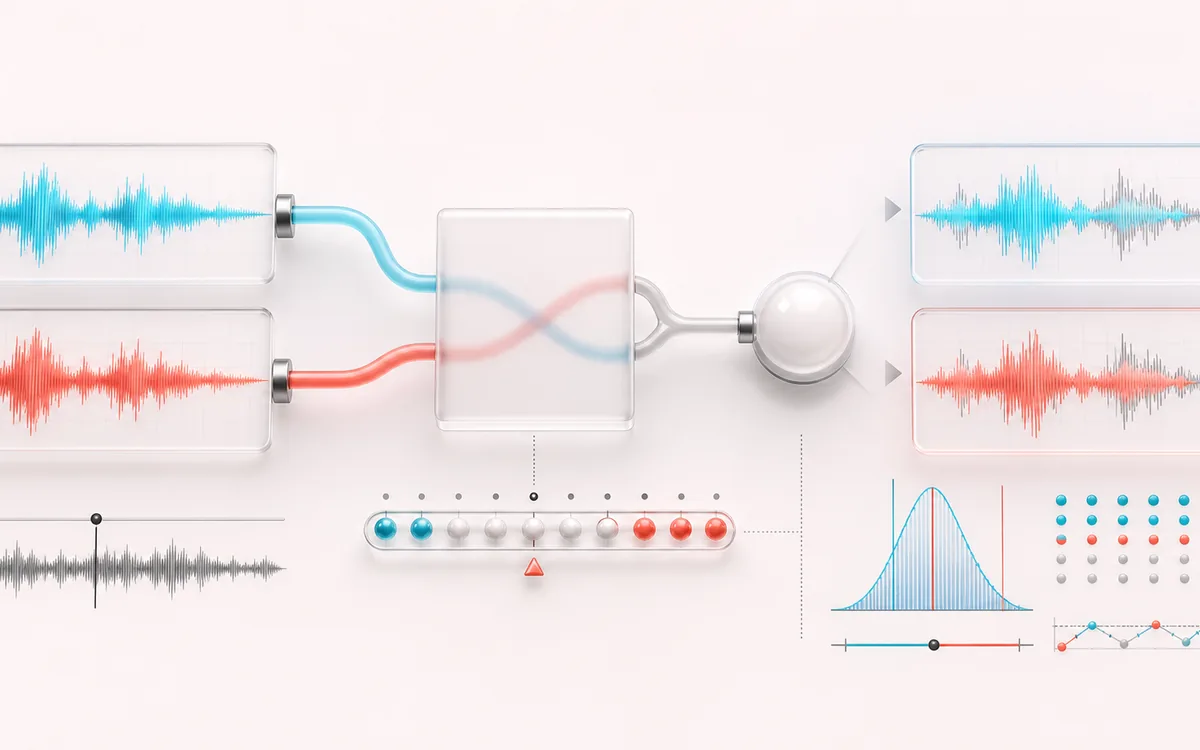
MEASUREMENT MAP
Blind Comparison Trials
Turn a signal into evidence you can inspect. A useful analyzer connects the raw trace, the measurement window and a clearly labeled result without pretending that one number explains the whole recording.
Open the full signal breakdownBest source, processing logic, limits and three-pass listening check
- Candidate A and B
Start with the right material
Checking whether you can reliably hear a codec, EQ, master, plugin or export difference instead of relying on expectation.
- Randomize X trials
Understand the transformation
Both sources run on the same local timeline; optional bounded RMS matching reduces level bias, while each trial assigns X to A or B and reveals it only after the answer.
- ABX result
Verify the usable result
A completed 5, 10, 15 or 20-trial session with correct answers, success rate and a binomial chance-result calculation.
Where this workflow stops
ABX can reduce identity bias but does not control headphones, room, fatigue, source alignment or sample selection. A low chance result is not proof that one version is better.
Make the final decision by ear
- Use the same window and settings when comparing two files.
- Treat estimates as evidence, not as a substitute for listening.
- Export or note the measurement context alongside the result.
- Input
- Two mono or stereo audio files your browser can decode, or a deterministic generated demo pair.
- Listening
- One synchronized playhead for A, B and X, a selected loop, optional attenuation-only RMS matching and keyboard controls.
- Result
- Correct answers out of total trials and the exact binomial probability of at least that score under 50/50 random guessing.
How to run an ABX audio test online
- Choose two local audio files or open the deterministic demo, then confirm the common playable duration.
- Choose a short loop and optionally enable bounded RMS level matching so loudness is less likely to reveal the answer.
- Choose 5, 10, 15 or 20 trials, switch freely between A, B and X at one synchronized playhead, then answer whether X is A or B.
- Review correct answers and the probability of at least that score under random guessing, then reset or start a new randomized session.
ABX versus a normal A/B audio player
An ordinary A/B player is useful for fast comparison, but both labels are always known. Expectation can influence what you notice. ABX adds a third label, X, which is secretly assigned to A or B on every trial. You must make a forced choice before the assignment is revealed.
This comparator still lets you learn the references by switching A and B. During a session, A, B and X all use the same two concurrently running Web Audio sources, loop and playhead. Switching changes gain rather than restarting either file.
Why level matching matters
Even a small level difference can make the louder file seem clearer or better. Optional RMS matching samples power inside the selected loop, then attenuates only the louder source. It never boosts, never exceeds 12 dB of attenuation and does not rewrite either file.
RMS is not perceived loudness, LUFS or peak matching. Different dynamics and frequency balance can remain obvious. For careful work, prepare truly aligned sources from the same master and compare a short, repeatable section on familiar playback equipment.
What the chance probability means
For n completed two-choice trials and k correct answers, the tool reports the binomial upper tail: the chance of obtaining at least k correct if every answer were an independent 50/50 guess. For example, 5 out of 5 has a random-guess tail of 3.125%.
A low value is not proof of audibility and is not a scientific certificate. Repeating sessions until one looks impressive, changing loops after seeing results, receiving visual cues, comparing misaligned files or stopping early all change how the number should be interpreted.
Practical limits and privacy
- Sources must overlap for at least one second. The available timeline ends with the shorter decoded file.
- This browser tool does not time-align different edits, remove codec delay or confirm that A and B differ in only one intended way.
- File size, duration and combined decoded PCM limits protect the tab from unsafe memory use.
- Selected files stay on this device; normal page assets are still loaded from AudioWrench.
ABX Audio Test & Comparator: quick answer and technical limits
Quick answer: A blind listening test that keeps two decoded sources synchronized, hides whether X is A or B and scores repeatable choices without revealing the answer early.
- Best for
- Checking whether you can reliably hear a codec, EQ, master, plugin or export difference instead of relying on expectation.
- How it works
- Both sources run on the same local timeline; optional bounded RMS matching reduces level bias, while each trial assigns X to A or B and reveals it only after the answer.
- What you get
- A completed 5, 10, 15 or 20-trial session with correct answers, success rate and a binomial chance-result calculation.
Know before you use it: ABX can reduce identity bias but does not control headphones, room, fatigue, source alignment or sample selection. A low chance result is not proof that one version is better.
Privacy: Selected audio is processed in this browser and is not uploaded to AudioWrench. Normal page assets can still be requested as described in the privacy notice. Privacy details →