Do binaural beats work? A plain, honest answer.
Short version: the stereo illusion is real, but evidence for dependable focus, sleep or health outcomes is mixed. Here is how binaural beats are made and what the preset labels actually mean.
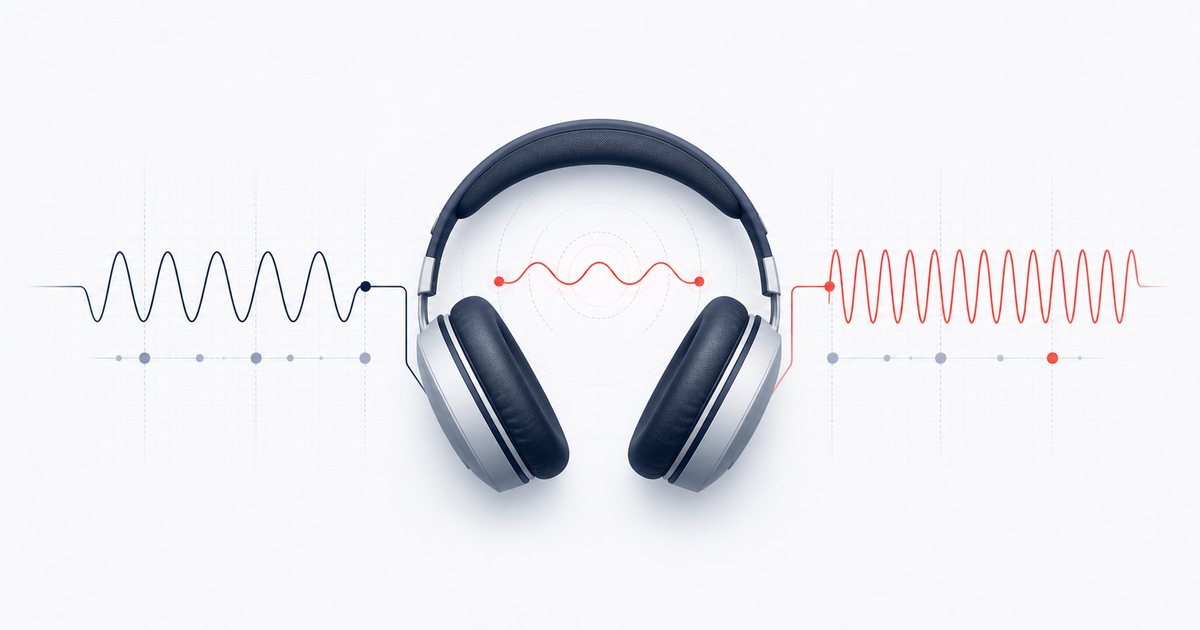
What a binaural beat actually is
A binaural beat is an auditory illusion. Play one steady tone in your left ear — say 200 Hz — and a slightly different tone in your right ear — say 210 Hz — and you may perceive a gentle pulse at the difference between them: 10 Hz in this case. The binaural pulse is a percept rather than a third tone in the air, which is why controlled left/right separation matters. On speakers both channels reach both ears; acoustic or monaural beating may remain, but the intended one-tone-per-ear presentation collapses.
The proposed mechanism is often called "entrainment": the hypothesis that a steady perceived pulse may influence measured brain activity. That hypothesis does not make a preset a validated way to create sleep, focus or a particular mental state.
So — do binaural beats work?
The acoustic illusion is established, but the outcome question is less certain. Research on binaural beats for anxiety, focus and sleep is mixed, studies are often small, and protocols vary. That is not robust support for claims such as instant focus, guaranteed deep sleep or medical benefit.
A steady sound may still be a listening preference or personal routine. The careful expectation is simply a configurable background sound: it may feel pleasant, neutral or distracting depending on the listener.
How to make binaural beats step by step
The AudioWrench Binaural Beats generator builds the tones live in your browser, so there is no source recording to upload to AudioWrench. Here's the real flow:
- Put your headphones on first. The tool needs separate left/right delivery for the intended binaural presentation. Any stereo headphones or earbuds are fine.
- Pick a preset label. Delta, Theta, Alpha, Beta and Gamma are conventional frequency-band names, not validated prescriptions for sleep, meditation or focus. The readout shows the exact left and right tones.
- Dial it in with the sliders. Adjust the carrier frequency (the base pitch, 50–500 Hz), the beat frequency (0.5–40 Hz, the pulse you feel), and the volume. Lower carriers sound deeper; lower beats feel slower.
- Add background pink noise if you like. A blend slider mixes in pink noise that may mask some room sounds. Keep the level comfortable.
- Press Play to preview. The tones fade in smoothly. Set the optional sleep timer (5–60 minutes) and the session will gently fade out on its own.
- Download a session for offline listening. Choose a length (1, 5 or 10 minutes), and the tool renders the whole session on your device and gives you a clean audio file to keep on your phone or player.
🧠 Try the Binaural Beats generator (free) →
What the preset labels mean
- Delta: a very slow difference frequency, around 2 Hz in this generator.
- Theta: a slow difference frequency, around 6 Hz.
- Alpha: around 10 Hz.
- Beta: a faster pulse, around 20 Hz.
These labels describe the configured difference frequency; they do not validate an outcome. There is no proven correct number for focus or sleep, so choose only by listening comfort.
A quick safety note
This is a sound generator, not a medical device, treatment or clinically validated focus or sleep aid. Keep the volume comfortable, stop if it causes discomfort, and do not use distracting audio while driving or operating machinery. Ask a qualified clinician about personal health concerns.
Why do it in your browser?
Because it's a simple way to try the effect without an account. The tones are synthesised in your browser with the Web Audio API and the downloadable session is rendered locally; there is no source recording to upload to AudioWrench. Normal page assets still load over the network. There is no sign-up wall or paid frequency tier, and the audio generation itself happens on-device.
FAQ
Do binaural beats work?
Do I really need headphones for binaural beats?
Which frequency should I pick for focus or sleep?
Is the AudioWrench binaural beats tool free, and is anything uploaded?
Sources and review notes
The acoustic beat is real, but broad claims about brainwave entrainment or guaranteed psychological outcomes are not established.
- Systematic review of binaural-beat entrainment — Reviews inconsistent methods and EEG findings.
- WHO safe-listening guidance — Practical headphone listening precautions.