Online Sample Pack Builder
Load many separate samples, arrange the crate, batch-trim silence, normalize peaks, add clean fades and deliver consistent WAVs with collision-safe names, JSON/CSV manifests and one local ZIP.
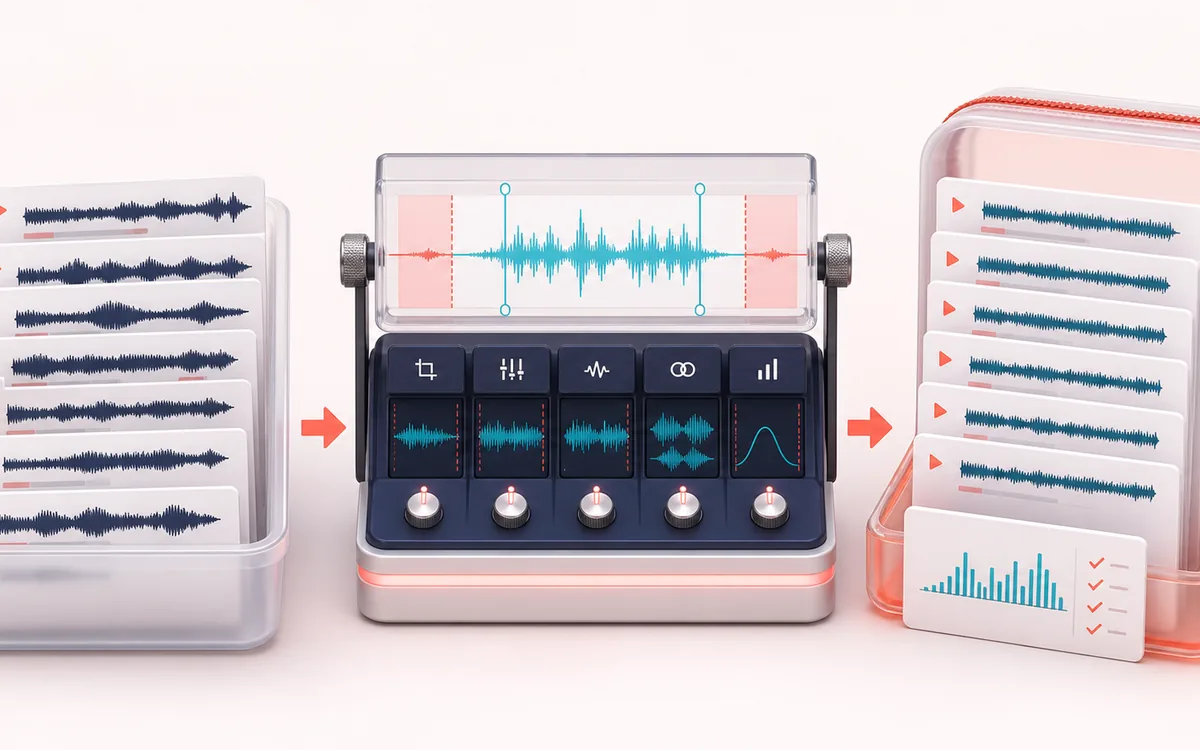
FILE STRUCTURE MAP
Sample Pack Assembly
Follow audio, metadata and delivery as separate layers. Container work is easier to trust when decoded audio, editable fields and the final export are shown as distinct stages with explicit preservation limits.
Open the full signal breakdownBest source, processing logic, limits and three-pass listening check
- Loose sample batch
Start with the right material
Turning loose drum hits, one-shots, field recordings or sound effects into an ordered, consistently rendered pack for a sampler or DAW.
- Trim normalize rename
Understand the transformation
Each selected queue item is decoded independently, bounded silence trim and padding choose its retained range, optional mono conversion and resampling set delivery dimensions, then peak normalization and short edge fades are applied.
- Packaged sample ZIP
Verify the usable result
Previewable processed samples plus individual WAV files or one local ZIP containing unique outputs and a compact JSON or CSV manifest.
Where this workflow stops
Automatic silence thresholds can trim quiet attacks or tails, peak normalization is not loudness matching, and batch decoding can use significant device memory. This prepares separate files rather than slicing one recording.
Make the final decision by ear
- Keep the untouched original until the exported file is verified.
- Confirm sample rate, channels, duration and metadata independently.
- Test the delivery in the application or device that will consume it.
- Input
- Multiple independent browser-decodable files in an editable, previewable queue.
- Batch recipe
- Silence trim with padding, target peak, fades, channel delivery, sample rate and naming template.
- Delivery
- Individual PCM WAVs or one dependency-free STORE ZIP with CRC-valid WAV, JSON and CSV entries.
How to build a sample pack online
- Choose multiple separate audio samples or generate the three-item authored demo pack.
- Reorder, remove and preview items so the crate matches the intended delivery sequence.
- Set silence threshold and padding, peak target, fades, channel/sample-rate delivery and naming recipe.
- Build locally, preview processed items, then download WAVs or one ZIP with JSON and CSV manifests.
One recipe across many independent files
Sample Pack Builder starts with separate files and keeps their queue order. Each item is trimmed only at its outside silent edges, then normalized, faded, channel-converted, sample-rate-converted and named. It does not split one recording into regions like Transient Slicer or Audio Splitter, and it does not rewrite embedded metadata.
Predictable trim and naming
The trim threshold is measured against absolute decoded PCM amplitude across all channels. Padding is added inside the available source bounds. Naming templates combine a sanitized prefix, zero-padded queue index and original basename; duplicate results receive deterministic suffixes instead of overwriting another sample.
Limits worth knowing
- Silence trim is amplitude-based. Room tone above the threshold stays; quiet intended tails below it may be removed.
- Peak normalization measures sample peaks, not loudness, LUFS or intersample true peaks.
- Linear sample-rate conversion is suitable for short pack delivery but is not claimed as mastering-grade band-limited resampling.
- Empty/silent inputs remain a short valid silent WAV rather than producing invalid zero-frame audio.
- The batch is limited to 64 files, 200 MB of selected compressed files, 12 minutes per item and the local decoded-memory preflight.
Privacy: selected samples are decoded, previewed, processed, encoded and packaged on this device. They are not sent to AudioWrench. Normal page assets may still be requested when the page loads.
Sample Pack Builder: quick answer and technical limits
Quick answer: A batch delivery workspace that prepares several separate source samples with consistent silence trim, peak level, edge fades and collision-safe names.
- Best for
- Turning loose drum hits, one-shots, field recordings or sound effects into an ordered, consistently rendered pack for a sampler or DAW.
- How it works
- Each selected queue item is decoded independently, bounded silence trim and padding choose its retained range, optional mono conversion and resampling set delivery dimensions, then peak normalization and short edge fades are applied.
- What you get
- Previewable processed samples plus individual WAV files or one local ZIP containing unique outputs and a compact JSON or CSV manifest.
Know before you use it: Automatic silence thresholds can trim quiet attacks or tails, peak normalization is not loudness matching, and batch decoding can use significant device memory. This prepares separate files rather than slicing one recording.
Privacy: Selected audio is processed in this browser and is not uploaded to AudioWrench. Normal page assets can still be requested as described in the privacy notice. Privacy details →