Song Key Finder.
Drop a song to estimate its musical key, scale and Camelot code — plus nearby harmonic options for DJ transitions. Confirm by ear: relative keys and ambiguous tracks can be misclassified.
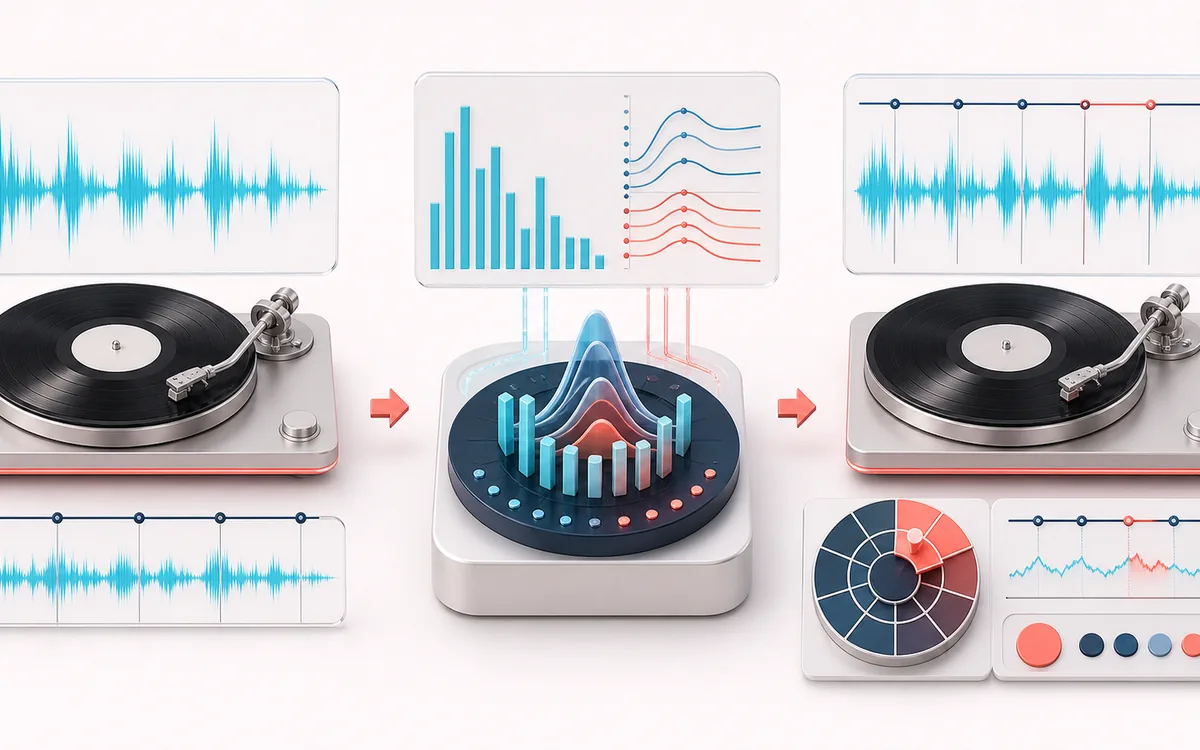
MEASUREMENT MAP
Key Profile Wheel
Turn a signal into evidence you can inspect. A useful analyzer connects the raw trace, the measurement window and a clearly labeled result without pretending that one number explains the whole recording.
Open the full signal breakdownBest source, processing logic, limits and three-pass listening check
- Unknown song
Start with the right material
Rough DJ preparation, karaoke key checks and a first pass before harmonic mixing.
- Compare pitch classes
Understand the transformation
FFT-derived chroma energy is matched against Krumhansl-style major/minor profiles.
- Key and scale result
Verify the usable result
One estimated tonic, major/minor mode and corresponding Camelot code.
Where this workflow stops
Modal, atonal, changing-key and harmonically sparse tracks may be misclassified. Confirm by ear before transposing or performing.
Make the final decision by ear
- Use the same window and settings when comparing two files.
- Treat estimates as evidence, not as a substitute for listening.
- Export or note the measurement context alongside the result.
How to find a song's key
- Drop a track into the upload panel — MP3, WAV, FLAC and other common formats are supported.
- Wait a few seconds while the key and tempo analysis runs on your device.
- Read the big result cards: musical key, Camelot code and BPM.
- Use the compatible-keys chips to line up your next track for a smooth, harmonic transition.
This song key finder compares a track's tonal profile with major and minor templates, then reports the most likely key and its Camelot code. It also shows neighbouring codes that DJs commonly try for harmonic mixing. The result is a statistical estimate, not a guarantee: relative major and minor keys, key changes and ambiguous material can be misclassified, and even a compatible Camelot code does not ensure every passage will mix cleanly. Everything is computed locally in your browser, with no signup or upload of your music.
Song Key Finder: quick answer and technical limits
Quick answer: A musical-key estimator that compares a track’s chroma profile with major and minor key templates and returns a Camelot label.
- Best for
- Rough DJ preparation, karaoke key checks and a first pass before harmonic mixing.
- How it works
- FFT-derived chroma energy is matched against Krumhansl-style major/minor profiles.
- What you get
- One estimated tonic, major/minor mode and corresponding Camelot code.
Know before you use it: Modal, atonal, changing-key and harmonically sparse tracks may be misclassified. Confirm by ear before transposing or performing.
Public browser workflow evidence
Question: Can the browser-resampled analyser return the exact authored tonic, major/minor mode and Camelot code for six deterministic chord progressions?
Observed result: All 6 authored progressions matched exact tonic, mode and Camelot code: C major (8B), D major (10B), F major (7B), G major (9B), A minor (8A), E minor (9A).
Evidence boundary: Six clean triad progressions do not establish accuracy for modal, atonal, noisy, sparse or changing-key recordings. Treat every real-song result as an estimate.
Network observation: No audio-payload or cross-origin requests were observed during this published workflow.
Privacy: Selected audio is processed in this browser and is not uploaded to AudioWrench. Normal page assets can still be requested as described in the privacy notice. Privacy details →