BPM Detector, Checker & Analyzer.
Check a track's BPM, compare half-time and double-time interpretations, inspect tempo changes, and export the evidence — locally in your browser.
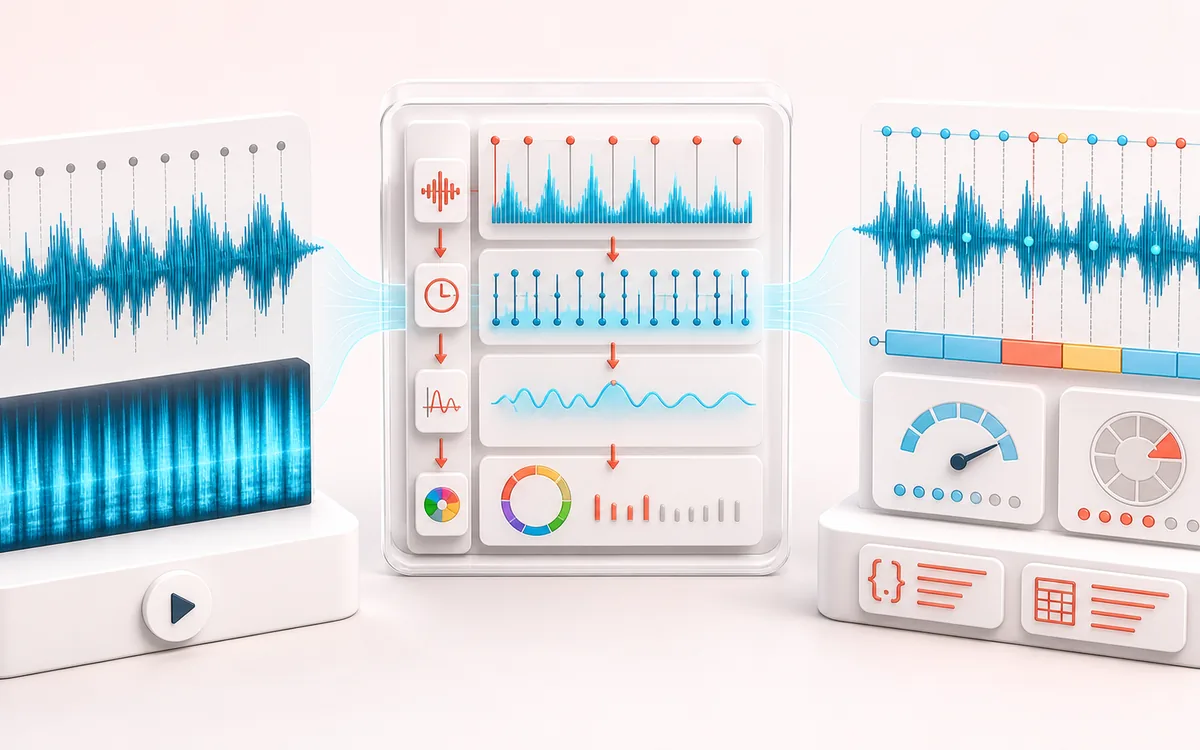
MEASUREMENT MAP
Tempo Pulse Evidence
Turn a signal into evidence you can inspect. A useful analyzer connects the raw trace, the measurement window and a clearly labeled result without pretending that one number explains the whole recording.
Open the full signal breakdownBest source, processing logic, limits and three-pass listening check
- Unknown music track
Start with the right material
DJ library triage, choosing the right metrical count, spotting broad tempo changes and documenting an unknown track before editing.
- Estimate beat and key
Understand the transformation
Up to 16 bounded segments use onset energy, stable adjacent-onset intervals and normalized autocorrelation fallback; chroma matching supplies a separate key and Camelot estimate.
- BPM and Camelot result
Verify the usable result
A chosen BPM interpretation, evidence label, tempo segment map, key/Camelot suggestion, source facts and versioned JSON/CSV analysis.
Where this workflow stops
Evidence labels summarize repetition and usable coverage, not accuracy. The map is not a beat grid; swing, sparse onsets, polyrhythms, rubato and harmonic ambiguity can still mislead either estimate.
Make the final decision by ear
- Use the same window and settings when comparing two files.
- Treat estimates as evidence, not as a substitute for listening.
- Export or note the measurement context alongside the result.
How to check BPM, tempo changes and key
- Drop a track into the BPM analyzer — MP3, WAV, FLAC and other browser-decodable formats work.
- Wait while a serialized header/metadata preflight estimates memory before PCM decode, followed by bounded onset and segment analysis. No selected audio is sent to AudioWrench.
- Compare the explicit half-time, original and double-time values, then choose Use this BPM for the count that matches the groove.
- Inspect the evidence label, source facts and segment tempo map before exporting a matching JSON or CSV analysis receipt.
- No file handy? Tap the tempo pad in time with the music to calculate BPM from your recent taps.
This free online BPM detector, BPM checker and tempo analyzer measures repeating onset spacing, then keeps the common metrical ambiguity visible instead of hiding it behind one number. The selected BPM can help with DJ library prep, sample matching and project-tempo triage. The musical key and Camelot code are separate tonal estimates. All results are evidence-led suggestions, not guaranteed ground truth.
BPM Detector: quick answer and technical limits
Quick answer: A bounded tempo and key analyzer with selectable half/original/double BPM, segment-level stability evidence and portable JSON/CSV receipts.
- Best for
- DJ library triage, choosing the right metrical count, spotting broad tempo changes and documenting an unknown track before editing.
- How it works
- Up to 16 bounded segments use onset energy, stable adjacent-onset intervals and normalized autocorrelation fallback; chroma matching supplies a separate key and Camelot estimate.
- What you get
- A chosen BPM interpretation, evidence label, tempo segment map, key/Camelot suggestion, source facts and versioned JSON/CSV analysis.
Know before you use it: Evidence labels summarize repetition and usable coverage, not accuracy. The map is not a beat grid; swing, sparse onsets, polyrhythms, rubato and harmonic ambiguity can still mislead either estimate.
Public browser workflow evidence
Question: Can the real UI recover controlled 80, 100, 128 and 160 BPM pulse trains and disclose its intentional half/double-time folding at 60 and 200 BPM?
Observed result: All 6 cases passed. Exact grid: 80→80 BPM, 100→100 BPM, 128→127.7 BPM, 160→160 BPM. Declared half/double-time interpretations: 60→120 BPM, 200→100 BPM.
Evidence boundary: These fixtures are steady synthetic click grids. Swing, syncopation, rubato, changing tempo and mastered music remain outside this wave.
Network observation: No audio-payload or cross-origin requests were observed during this published workflow.
Privacy: Selected audio is processed in this browser and is not uploaded to AudioWrench. Normal page assets can still be requested as described in the privacy notice. Privacy details →